What Is a Virtual Observatory? How Astronomy Went Online
From ViRBO
For most of history, looking at the sky meant owning the right equipment and standing in the right place at the right time. A virtual observatory quietly overturned that arrangement. Instead of pointing a telescope yourself, you point a browser at decades of observations other people already gathered — and the sky, in effect, comes to you. The same instinct that draws people to a well-indexed catalogue of anything online, from research archives to a page of top online slots, is exactly what a virtual observatory rewards: everything gathered in one searchable place, ready the moment you are.
This guide walks through what a virtual observatory is, how it grew out of a very practical problem, how a virtual astronomical observatory works under the hood, and how you can start using one today.
1. The Virtual Observatory, in Plain Terms
A virtual observatory is not a building, and it is not a telescope. It is a network of data archives, catalogues, and software tools that behave as though they were a single instrument. You send it a question — show me everything recorded near this patch of sky — and it answers by reaching into many separate collections at once.
The idea matters because astronomy has a storage problem most people never see. Every night, telescopes and satellites record far more than any one team can analyze. Those recordings pile up in institutional archives that were never designed to talk to each other. A virtual observatory is the connective tissue that finally lets them.
A virtual observatory turns scattered, incompatible archives into something a single person can search in an afternoon.
ViRBO itself — the Virtual Radiation Belt Observatory this site was built for — is a working example. It gathered radiation-belt measurements from dozens of missions and gave researchers one place to find them, instead of dozens of dead ends.
2. From Telescope Time to a Shared Catalogue
To appreciate the shift, it helps to remember how observations used to be shared: mostly, they weren't. A team won telescope time, recorded its data, published a paper, and moved on. The raw measurements often stayed on a local disk, useful to one lab and invisible to everyone else.
That model wasted an enormous amount of already-collected science. By the early 2000s, several national efforts set out to fix it by agreeing on common formats and shared search protocols. The result was a genuine change in what "doing astronomy" could mean.
| Era | How you got data | Who could take part |
|---|---|---|
| Traditional | Apply for telescope time, observe in person | Funded teams with instrument access |
| Early archives | Request files from each institution separately | Specialists who knew where to look |
| Virtual observatory | Query many archives at once from a browser | Anyone with an internet connection |
The last row is the quiet revolution. A curious student in a small town can now interrogate the same sky surveys as a major research institute — with the same tools and the same access.
3. How a Virtual Astronomical Observatory Actually Works
Under the hood, a virtual astronomical observatory relies on a few unglamorous but essential agreements. The magic is less about clever telescopes and more about everyone describing their data the same way.
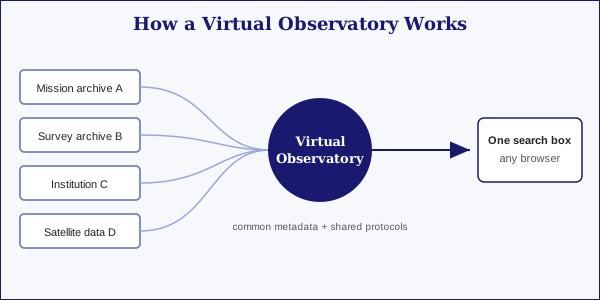
Three ingredients do most of the work:
- Common metadata — every dataset describes itself in a shared vocabulary, so a search engine knows what it is holding.
- Standard protocols — archives expose the same kinds of query endpoints, so one request can fan out to many of them at once.
- Interoperable tools — visualization and analysis software can pull from any compliant archive without custom code.
Standards are boring to build and transformative to use. They are the reason a single query can touch a dozen archives.
When you run a search, the system translates your request into each archive's native language, collects the responses, and hands you a unified result. You experience one clean catalogue; behind the curtain, many institutions just answered together, in the same breath.
4. Why It Matters Beyond the Ivory Tower
It is tempting to file all of this under "for professional astronomers only." That undersells it badly. The virtual observatory model quietly reshaped public expectations about access to data of every kind.
Consider how normal it now feels to open any large online service and expect a fast, filterable catalogue — whether you are searching a library, comparing flights, or scanning a curated list of top online slots at a site like Rollambia. In each case you are leaning on the same underlying idea the virtual observatory helped popularize: a huge, messy pile of records, tamed into something you can search in seconds. Astronomy was an unlikely pioneer of that experience, precisely because its data volumes forced the issue years before most industries felt the pressure.
The scientific payoff is real, too. Discoveries increasingly come from combining archives — spotting a faint signal in old data that only becomes meaningful next to a newer measurement. That kind of cross-checking is only practical when the archives are federated and speak a common language.
5. Getting Started With Virtual Observatory Tools
You do not need credentials or a research grant to explore a virtual observatory. Most are open, and the entry cost is curiosity plus a little patience with unfamiliar vocabulary.
A sensible first session looks like this:
- Pick one portal and stay with it long enough to learn its search box.
- Start with a named object or a sky coordinate you already care about.
- Note which archive each result came from — provenance always matters.
- Export a small dataset and open it in a free viewer before scaling up.
- Read the data description, not just the plot, so you understand its limits.
| If you want to… | Start with… | Watch out for… |
|---|---|---|
| Browse by object | A name-resolver search | Duplicate entries across surveys |
| Compare over time | Multi-mission archives | Differing calibration between instruments |
| Visualize quickly | An interoperable desktop tool | Very large files that need filtering first |
The learning curve is gentler than it looks, once you accept that the hardest part was never yours to solve — the standards did it years ago. A virtual observatory simply hands you the result: a sky's worth of data, waiting behind a single search box.
Astronomy went online not with one heroic telescope, but with a quiet agreement to share. That is the real story of the virtual observatory — and it is why anyone, anywhere, can now start exploring the sky tonight.
